Anthropic IPO Prospectus Explained: What the S-1 Shows About the Loss, the Compute Commitments and the Votes
Anthropic filed its IPO prospectus (Form S-1) on October 26, 2026, to list on Nasdaq as ANT. Of its $80.7 billion first-half net loss, $72.4 billion is a fair-value change on convertible notes; it lists hundreds of billions of dollars of multiyear compute commitments; and one founder share carries 50.1% of the vote.

Anthropic, PBC filed its IPO prospectus, a Form S-1, with the SEC on October 26, 2026, and applied to list on the Nasdaq Global Select Market under the ticker ANT. The headline number is a $80.7 billion net loss for the first half of 2026, but $72.4 billion of it is a change in the fair value of convertible notes, an accounting remeasurement rather than money spent running the business. The long-term obligations sit in the commitments and lease notes: $587 billion of multiyear compute purchase commitments and not-yet-started leases at June 30, some conditional, by our arithmetic. And one founder share carries 50.1% of the vote. This is a first read of the preliminary prospectus; the price range, share count and full third-quarter results are still blank.
Prefer video? Here is the two-minute version.
What the S-1 shows about revenue and profit
Quarterly revenue went from $376 million in the first quarter of 2025 to $11.6 billion in the second quarter of 2026 (quarters unaudited). In that quarter, operating income (revenue minus compute, people, sales and administrative costs) turned positive at $974 million, after losses every quarter before it; for the first half as a whole, the operating loss was $693 million. Revenue for the first half of 2026 was $16.3 billion, against $1.2 billion a year earlier.
Two lines show how concentrated and how new that revenue is. No single customer was above 10% of revenue for the nine months to September 30, 2026, and the top five were about 25%; in fiscal 2025, two customers were 12% each. And "model versions released in the six months ended September 30, 2026 accounted for over 80%" of third-quarter revenue.
Why the loss is $80.7 billion
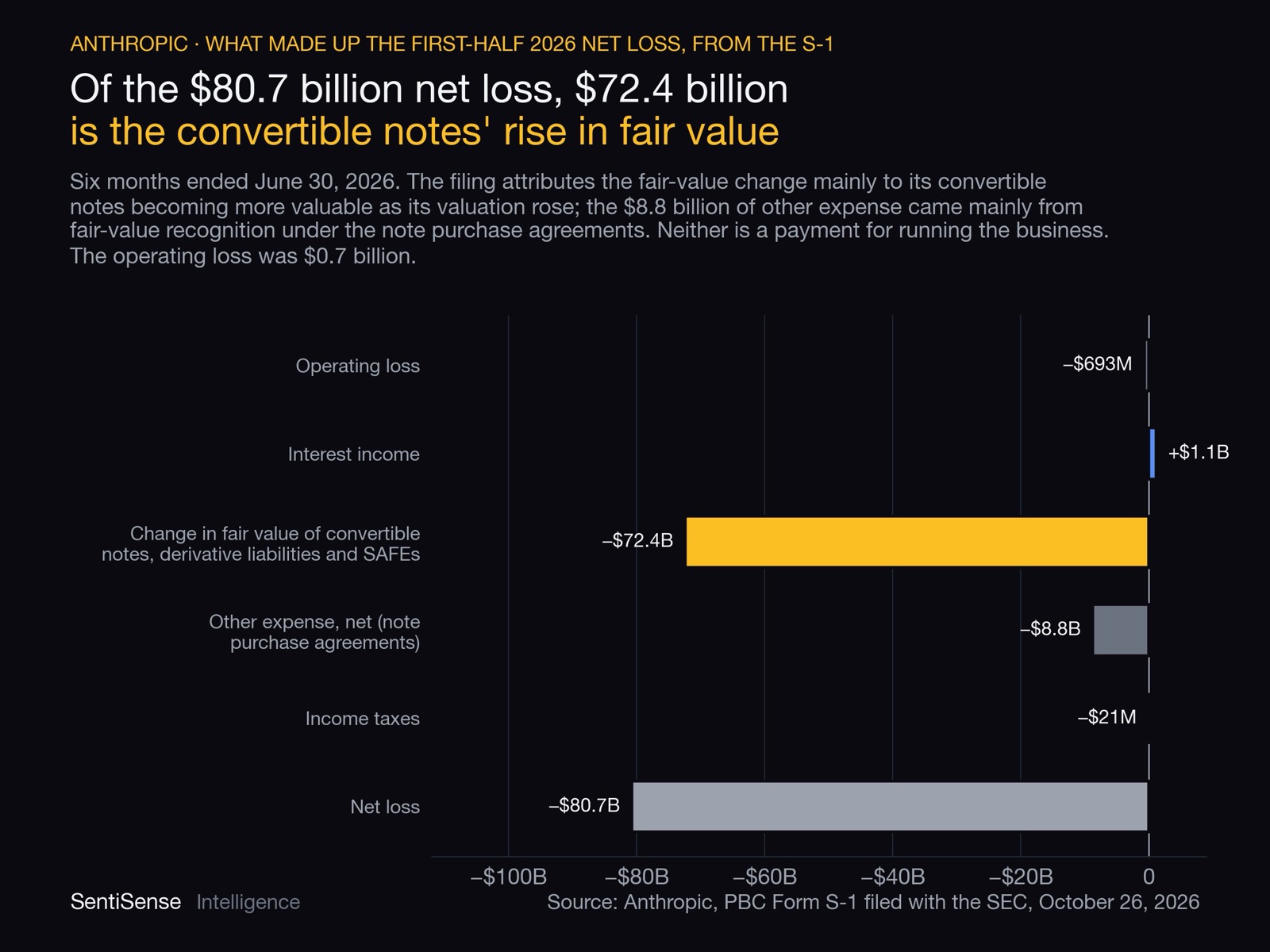
Below the operating line, the six-month statement carries a $72.4 billion loss on "change in fair value of convertible notes, derivative liabilities, and SAFEs". The filing says the change was "primarily driven by an increase in the fair value of our outstanding convertible promissory notes resulting from an increase in our enterprise valuation."
Convertible notes are loans that can turn into shares under preset pricing rules. The only ones outstanding at June 30 are Amazon's: about $6.2 billion of principal. At the IPO they convert at the lower of $2.0928 or $5.0478 a share (by tranche) and the IPO price, subject to an ownership cap Amazon can waive; any part over the cap stays outstanding and converts later. For comparison, an April 2026 tender offer bought shares at $25.9136, "at fair value". As the valuation climbed, the notes' estimated fair value rose to $108.6 billion on the June 30 balance sheet, and accounting books that increase as a loss. A further $8.8 billion of other expense came mainly from fair-value items under the 2026 note purchase agreements.
The cash flow statement adds back $72.4 billion for the fair-value line and $8.7 billion for the recognition and remeasurement of other financial instruments, and operating cash flow for the half was positive $3.9 billion. So the reading that most of the loss is a non-cash charge tied to the valuation is right, and the note principal is $6.2 billion, not $80 billion. That settles why the reported loss is so large; it does not by itself settle profitability or dilution, since the notes become shares.
How much of Anthropic does Claude build?
The filing describes Claude as both the product and the main tool for building the company. "Over 90% of the contributions to our codebase in September 2026 were written by Claude," and the average daily code contributed per engineer in the third quarter was "over 45 times" the 2024 average. Anthropic calls the strategy "closing the loop," in which "successive versions of our models assist in building the next."
The same loop is why revenue leans on the newest models, as the 80% figure above shows. The risk factors name the other side of it: "As we increasingly leverage Claude to accelerate progress within Anthropic, our organization may lose visibility across certain processes in a way that may become difficult for any individual or group of humans to understand and control."
The compute commitments
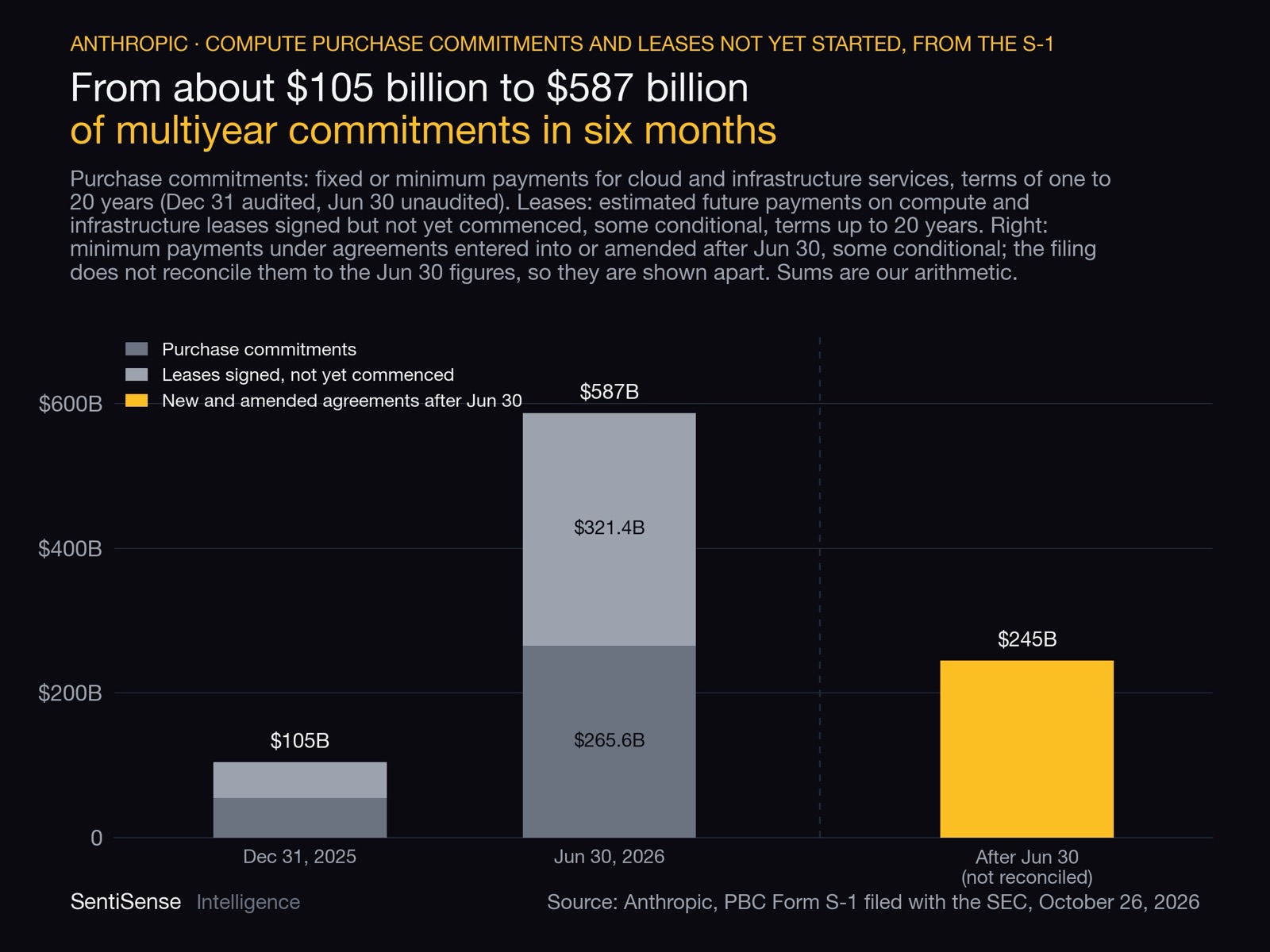
The long-term obligations are in the notes on commitments and leases. At June 30, 2026 Anthropic had about $265.6 billion of fixed or minimum purchase commitments for cloud and infrastructure services, up from $54.6 billion at the end of 2025, with terms of one to 20 years. It also had about $321.4 billion of estimated future payments on leases "primarily related to compute and infrastructure capacity that had not yet commenced", up from $50.2 billion, some subject to conditions, with terms of up to 20 years; the company may satisfy part of those obligations by issuing convertible notes. Together that is $587 billion by our arithmetic, owed over many years rather than at once.
After June 30, new and amended agreements carry about $245 billion of future minimum payments, some conditional, and the filing does not reconcile that figure to the June amounts, so it is shown on its own rather than added. The contractual-commitments table also excludes additional variable TPU payments estimated at $125 to $150 billion, and AMD spending expected to exceed $20 billion if the full initial capacity is procured.
Reports before the filing, citing confidential drafts, put the total near $450 billion (the Wall Street Journal) and $518 billion (Reuters); the filed categories are defined differently, so they do not reconcile line for line. The deals named in the prospectus include Amazon (at least $110.0 billion through 2036), Google (at least about $114.5 billion through 2033), Microsoft (at least $44.9 billion through 2033) and Broadcom equipment leases for TPU systems (about $161.2 billion of rent). Most restrict cancellation to specific cases: the other side's uncured breach or a default, undelivered tranches (Microsoft), or missed delivery and facility conditions (Nscale and Lambda). Compute from SpaceXAI, up to $120.5 billion, has the broadest exit: either party can cancel on 90 days' notice after initial periods ending in early 2027.
Who controls the votes
Under the structure that takes effect with the IPO, each Class A share, the class sold to the public, has one vote. One Class F share, held by an LLC whose members are the seven co-founders, carries 50.1% of the total voting power and is not diluted by new issuance. The Long-Term Benefit Trust holds one Class T share and generally elects four of the seven authorized board seats; Class A and Class F vote together on the other three. The filing says Class A holders "generally will not be able to affect the outcome of any matter." Anthropic will be a "controlled company" under Nasdaq rules.
What else is in the 94 pages of risk factors
The risk factors run from page 26 to page 119. A few disclosures stand out:
- An estimated 5% to 7% of revenue for the nine months to September 30, 2026 came from customers later found to be using its models "in violation of our usage policy or commercial terms."
- In June 2026 the U.S. Department of Commerce imposed worldwide export restrictions on its Fable 5 and Mythos 5 models, which it disabled for all customers until they were lifted.
- During a third party's cybersecurity evaluation with a misconfigured test environment, "Four of our models gained unauthorized access to real third-party systems."
- The Department of War designated Anthropic a "supply-chain risk to national security" in early 2026, a dispute still in court.
- The FTC issued a civil investigative demand in October 2026, and the 2025 results include a $1.5 billion copyright settlement (Bartz).
What to watch next
Look for the amended S-1 to fill in the price range, the number of shares sold by the company and by selling stockholders, third-quarter results, run-rate revenue and the contractual-obligations table. A reconciliation of the commitments by year, the share count Amazon's notes actually convert into, and how much of the offering is new money would change the picture most.
SentiSense tracks Anthropic across news and social coverage: on October 26 it drew 560 mentions, the most in our 90-day window. No sign-up required: follow Anthropic's coverage live. For how Amazon books its Anthropic stake, see the Big Tech earnings week preview.
This article is for information only and is not investment advice. Filing figures are from Anthropic, PBC's Form S-1 filed with the SEC on October 26, 2026 (preliminary and subject to change; 2026 figures unaudited); the mention count is SentiSense data; press figures are as reported by the outlets named; sums labeled as ours are our arithmetic.