HBM vs DRAM vs NAND vs Hard Drives in AI: What Each Does, Who Makes Which, and Does Sandisk Make DRAM?
HBM is DRAM stacked beside the AI chip, DRAM is the server's working memory, NAND flash is the SSD storage that holds datasets, model files and saved context, and hard drives hold the bulk. Who makes which, read from each company's own annual report; what each maker says about its own shortage; and the Sandisk question: it makes NAND flash with Kioxia, buys DRAM, and makes no HBM.

Sandisk announced an 8-for-1 stock split on October 29, 2026, alongside a quarter in which revenue rose 378% from a year earlier, and its stock closed 13.5% lower the next day. The name on the SD card in your camera is now one of the most-searched AI memory stocks, and the questions that come with it are the right ones. Is Sandisk just a reseller of cards, USB sticks and SSDs? Does it make DRAM? Is it the memory bottleneck?
The short answer, from Sandisk's own annual report: Sandisk makes NAND flash memory through joint ventures with Kioxia that run eight fabs in Japan, it buys DRAM as a component, it makes no HBM, and its link to AI is the storage tier, enterprise SSDs sold to data centers. The rest of this article is the map that answer sits on: what DRAM, HBM, NAND flash and hard drives each do in an AI data center, which companies make which, and what each of them says about where supply is short. Every figure comes from a company filing or release, listed at the end.
HBM vs DRAM vs NAND vs hard drives: what each does in AI
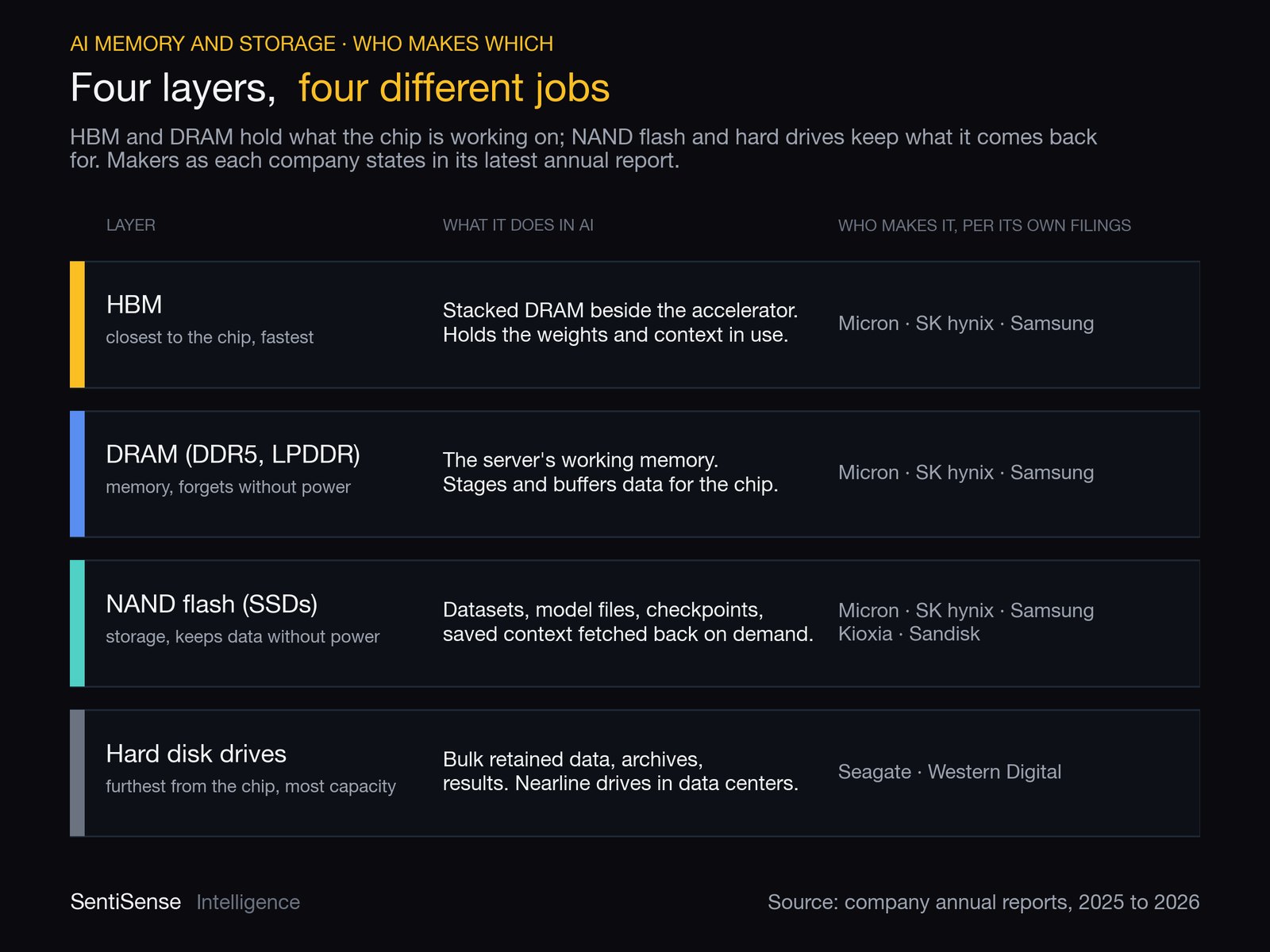
Four technologies, four jobs. The first two are memory: they hold what the processor is working on right now and forget it when the power goes. The second two are storage: they keep data between jobs.
| Layer | What it is | What it does in AI | Keeps data without power? |
|---|---|---|---|
| HBM (high bandwidth memory) | DRAM dies stacked vertically and placed beside the accelerator, connected by through-silicon vias. Micron's 10-K calls it "a 3D stacked DRAM architecture". | Holds the model weights and context the chip is actively computing on. Bandwidth feeds the chip; capacity limits what fits. | No |
| DRAM (DDR5, LPDDR) | Conventional memory chips on the server's CPU side. DDR5 is the standard server memory; LPDDR is the low-power family NVIDIA's Grace CPU uses. | The server's working memory: staging and buffering data before and after it reaches the accelerator. | No |
| NAND flash (SSDs) | The chip inside solid-state drives, memory cards and USB drives. NAND is the chip; the SSD is the drive built around it with a controller, firmware and some DRAM. | Holds training datasets, model files and checkpoints and, in newer inference systems, context evicted from GPU memory and fetched back. | Yes |
| Hard disk drives | Magnetic platters. Seagate and Western Digital design and manufacture the heads and media themselves. | Bulk storage for retained data, archives, long-term checkpoints and generated output. The high-capacity data-center models are called nearline drives. | Yes |
NVIDIA's own description of inference storage (March 16, 2026) uses the same ladder: GPU HBM for the "hot" context in active generation, system RAM for staging and buffering context off HBM, local SSDs for "warm" context reused over shorter timescales, and shared storage for "cold" artifacts, history and results. Micron reported on September 30, 2026 that its 7600 and 9650 SSDs are "now shipping to market-leading customers for KV-cache applications", the saved-context job in that third tier.
So "AI memory" is not one market. HBM and DRAM are the same technology at two distances from the chip; NAND and hard drives are two storage tiers behind them.
Who makes HBM chips, DRAM, NAND and hard drives?
Selling a branded SSD does not make a company a chip maker. This table reads each company's latest annual report for what it manufactures.
| Company | Makes | Its own words |
|---|---|---|
| Micron (MU) | DRAM including HBM, DDR and LPDDR; NAND; SSDs | "We manufacture our products at wholly-owned facilities." HBM4's base logic die and DRAM core dies "are designed and manufactured in-house." (fiscal 2026 10-K) |
| SK hynix | DRAM including HBM; NAND and enterprise SSDs, including Solidigm | Its 2025 annual report says it mainly produces DRAM and NAND flash; its Q3 2026 results expect HBM4 to be its mainstream product from the fourth quarter. |
| Samsung Electronics | DRAM including HBM; NAND; SSDs | "The DS Division manufactures and sells DRAM, NAND flash, and mobile APs." (2025 Business Report) |
| Kioxia | NAND flash; SSDs. No DRAM | "A specialized flash memory manufacturer"; its corporate history records a December 2001 decision to withdraw from commodity DRAM. (fiscal 2025 annual securities report) |
| Sandisk (SNDK) | NAND flash through its Kioxia joint ventures; SSDs, embedded flash, cards, USB drives. No DRAM, no HBM | "All of our flash memory wafers are currently obtained from Flash Ventures." "Some of our competitors offer products that we do not offer (including DRAM)." (fiscal 2026 10-K) |
| Western Digital (WDC) | Hard drives only, since it separated its flash business as Sandisk in February 2025 | "A leading developer, manufacturer, and provider of data storage devices and solutions based on hard disk drive technology"; continuing operations are "a single reportable segment, HDD." (fiscal 2026 10-K) |
| Seagate (STX) | Hard drives and storage systems; buys DRAM and NAND as components | "We design and manufacture HDDs, storage systems and related solutions"; DRAM and NAND flash memory are listed among the components it sources. (fiscal 2026 10-K) |
Three companies make HBM: Micron, SK hynix and Samsung. Five make NAND: those three plus Kioxia and Sandisk, the last two sharing the same Japanese fabs. Two make hard drives.
Does Sandisk make DRAM? Does Sandisk make its own chips?
Sandisk makes its own NAND chips and no DRAM.
Not a reseller. Sandisk's fiscal 2026 10-K describes "a vertically integrated solutions provider with ownership of chip-level design and IP, front and back-end manufacturing". Its flash comes from Flash Ventures, three joint ventures with Kioxia (Flash Partners, Flash Alliance and Flash Forward) that run eight fabs in Japan, six in Yokkaichi and two in Kitakami. Sandisk holds 49.9% of each, co-develops the process technology with Kioxia, is entitled to 50% of the output at cost plus a small markup, and pays half of the ventures' fixed costs whether or not it takes the wafers. Controllers are mostly designed in-house and made at third-party foundries; assembly and test happen at Sandisk's own plant in Penang, Malaysia, and at partners.
Micron is a competitor, not its source. The 10-K names "vertically-integrated suppliers such as Kioxia, Micron Technology, Inc., Samsung Electronics Co., Ltd., SK Hynix, Inc., Yangtze Memory Technologies Co., Ltd." as the competition. All of Sandisk's flash wafers come from the Kioxia ventures.
DRAM is something Sandisk buys. "Many of our enterprise-grade SSD products incorporate DRAM, which is a commodity component that has experienced supply constraints and may remain in short supply for extended periods." In March 2026 Sandisk bought about 139 million shares of Nanya Technology for $970 million, roughly 3.9% of the Taiwanese DRAM maker, with a multi-year arrangement under which "Nanya will supply the Company with DRAM products". High bandwidth memory does not appear in the 10-K at all. The DRAM squeeze reaches Sandisk as a buyer of a part, not as a seller.
What Sandisk makes for AI is storage. The 10-K: "the rapid growth of AI infrastructure is driving demand for high-performance storage products, and AI adoption is driving the need for NAND storage to support these workloads." In the quarter ended October 2, 2026, Datacenter revenue (enterprise SSDs for cloud and enterprise customers) was $4.80 billion of $11.03 billion, up from $269 million a year earlier. Edge, the flash inside PCs, phones, consoles and cars, was $5.83 billion. Consumer, the retail cards and drives, was $397 million, down 39% from a year earlier. Sandisk says it expects "AI-driven demand to persist through calendar year 2027 and beyond"; that is its forecast, not a measured fact.
Is there an AI memory shortage? Where the bottleneck is
Each maker reports its own layer as tight, and each statement describes a different thing: a manufacturing tradeoff, a seller's forecast, a price, or a volume commitment. Dated, in the companies' own words:
- HBM takes more fab per bit. Micron's fiscal 2026 10-K (October 9, 2026): HBM "requires a higher number of wafers and more cleanroom space to produce the same number of bits as conventional DRAM in the same technology node." That is why HBM growth can squeeze ordinary DRAM supply from the same fabs.
- SK hynix forecasts demand above supply through 2030. Its Q3 2026 results (October 28, 2026): "Given technical difficulty of leading-edge processes and the long lead time required to build new production facilities, it expects the structure in which demand exceeds supply to persist through 2030." It also said long-term agreements cover more than half of its 2027 to 2028 capacity. A forecast from the seller, not a settled outcome.
- Samsung: capacity constraints and higher prices. Its Q3 2026 release (October 29, 2026) says the Memory Business posted a record quarter "amid capacity constraints" and that "strong demand momentum for servers led to higher market prices across all applications." Micron's prepared remarks for its September quarter report DRAM prices up a "high-teens" percentage and NAND prices up "approximately 30%" from the prior quarter.
- Hard drives are sold out years ahead. Seagate's supplemental (October 27, 2026): "Vast majority of Data Center nearline supply allocated through CY28, with some cloud supply agreements extending through CY30." Western Digital's 10-Q (October 23, 2026) describes "greater manufacturing complexity and longer production lead times", with customers "extending the duration of their commercial arrangements."
No source ranks one layer as the bottleneck. For a training cluster, the HBM on the accelerator is the scarce part; inside a fab, HBM competes with conventional DRAM for wafers; for a cloud buying capacity, nearline drives are allocated through 2028. Which one binds depends on the workload and the contract. What the shortage costs the companies that buy memory, read from Apple's December-quarter margin guide and Sandisk's price-versus-volume lines, is in Why is RAM so expensive in 2026? Who pays.
Memory stocks for AI: the four US-listed names, latest quarter
| Company | What it sells | Latest quarter (revenue, change from a year earlier) | Data-center share of revenue | Guided next quarter |
|---|---|---|---|---|
| Micron (MU) | DRAM, HBM, NAND, SSDs | $54.23B, up 379%, quarter ended September 3, 2026 (reported September 30) | Cloud Memory and Core Data Center units: $34.29B, 63% | $61.5B, plus or minus $1.5B |
| Sandisk (SNDK) | NAND, SSDs, cards | $11.03B, up 378%, quarter ended October 2, 2026 (reported October 29) | Datacenter: $4.80B, 44% | $12.2B to $12.6B |
| Western Digital (WDC) | Hard drives | $4.38B, up 55%, quarter ended October 2, 2026 (reported October 22) | Cloud: $3.87B, 88% | $5.1B, plus or minus $0.1B |
| Seagate (STX) | Hard drives, storage systems | $4.23B, up 61%, quarter ended October 2, 2026 (reported October 27) | Data Center: $3.45B, 81% | $4.8B, plus or minus $0.1B |
Two footnotes the headline growth hides. Micron's fiscal 2026 had 53 weeks against 52 the year before, and Western Digital's year-earlier quarter had 14 weeks against 13, so both comparisons are slightly flattered. And "data center" or "cloud" is an end market, not AI revenue: none of the four reports an AI-only line.
The hard-drive rows answer the "hard drives, AI comeback" search with volumes and prices rather than a verdict: Western Digital's cloud revenue rose on more than 20% more exabytes shipped and about 25% higher average price per exabyte, and Seagate shipped 198 exabytes of nearline capacity in the quarter, up about 24% from a year earlier.
Is Sandisk stock going to split? The dates and the day after
Yes. Sandisk's 8-K of October 29, 2026: an eight-for-one forward split; stockholders of record at the close on Monday, November 9, 2026 receive seven additional shares per share, issued after the market close on Thursday, November 19; split-adjusted trading is expected from the open on Friday, November 20, under the same ticker. The authorized share count rises from 450 million to 3.6 billion. A forward split changes the share count, not the value of a holding: at the October 30 close of $1,150.89, one share becomes eight of about $143.86.
On October 30, the first session after the report, Sandisk closed at $1,150.89, down 13.5% from $1,330.05, after a run from $237.38 at the end of 2025, so it was still up about 385% this year after the fall. Micron, Western Digital and Seagate also closed lower that day, each on its own closes: down 5.3%, 7.4% and 8.0%. The report carried the 378% and, beside it, quarter-over-quarter growth of 23% and an outlook 11% to 14% above the quarter just reported. Which of those any seller was reacting to is not something a price chart can say.
No sign-up required. See Sandisk's earnings, news and filings on its SentiSense page, live →
Sources
All read November 1, 2026.
- Sandisk Corporation, Form 10-K for the fiscal year ended July 3, 2026, filed August 17, 2026: 10-K. Item 1 (products, end markets, Flash Ventures, competition), Item 1A (DRAM supply), Item 7 (AI demand) and the notes (the Nanya investment and supply arrangement).
- Sandisk Corporation, Form 8-K filed October 29, 2026: Item 8.01, the split terms, and Exhibit 99.1, fiscal first quarter 2027 results.
- Micron Technology, Form 10-K for the fiscal year ended September 3, 2026, filed October 9, 2026: 10-K, Item 1 and Item 1A. Fiscal fourth quarter 2026 results, September 30, 2026: Exhibit 99.1 to Form 8-K and prepared remarks.
- SK hynix, 2025 annual report (DART, March 17, 2026, Korean) and Q3 2026 results, October 28, 2026.
- Samsung Electronics, 2025 Business Report (April 30, 2026) and third quarter 2026 results, October 29, 2026.
- Kioxia Holdings, annual securities report for fiscal 2025: Japanese original (EDINET, June 24, 2026) and English translation.
- Western Digital, Form 10-K for the fiscal year ended July 3, 2026, filed August 14, 2026: 10-K; fiscal first quarter 2027 results, October 22, 2026: Exhibit 99.1; Form 10-Q filed October 23, 2026: 10-Q, Note 2 and MD&A.
- Seagate Technology, Form 10-K for the fiscal year ended July 3, 2026, filed August 4, 2026: 10-K; fiscal first quarter 2027 results, October 27, 2026: press release exhibit and supplemental financial information.
- NVIDIA, inference context memory storage platform, developer blog, March 16, 2026, and Grace CPU Superchip architecture (LPDDR5X).
- Daily closes for SNDK, MU, WDC and STX through October 30, 2026, pre-split: SentiSense market data.
Figures are as stated in the filings above on November 1, 2026 and are pre-split unless noted; the split timetable and every forecast quoted can change. This article is educational and is not investment advice.