How to Track Stock Market Sentiment in 2026
Market sentiment moves prices before fundamentals do, but tracking it is vague advice unless you know what to measure. Here is a practical guide to the three ways people track stock market sentiment, what separates a useful signal from noise, and how to watch it for free.

Everyone tells you to "watch market sentiment." Almost no one tells you how. It sounds like advice and lands like a vibe: scroll some headlines, skim a few posts, decide the mood feels bullish or bearish, and move on.
The problem is that sentiment is one of the few inputs that genuinely leads price. By the time a fundamental shows up in an earnings report, the conversation around the stock has usually already turned. So "track sentiment" is good advice. It just needs a method. Here is the practical version.
What market sentiment actually measures
Market sentiment is the tone of the conversation around an asset, separate from its price. It answers a different question than a chart does. A chart tells you what the stock did. Sentiment tells you how people are talking about it right now: optimistic, anxious, euphoric, capitulating.
Two things are worth keeping straight from the start:
- Sentiment is directional first, numeric second. The useful read is usually the label (bullish, neutral, bearish) and the direction it is moving, not a single decimal you stare at. A stock can be modestly negative and improving, which is a very different setup than modestly negative and deteriorating.
- Sentiment is not price, and that is the point. When the two disagree, that gap is the signal. Sentiment fading while price keeps climbing is worth a second look. So is sentiment turning up while the stock is still being sold.
Three ways to track market sentiment
There are really only three families of tools, and they measure different things. Most people only use the first one.
1. Price-derived fear and greed gauges. The classic example reads market data alone: momentum, breadth, volatility, put/call ratios, safe-haven demand. These are useful as a broad market thermometer, but notice what they leave out entirely: they never read a single word anyone said. They infer mood from price action, which means they cannot tell you mood is shifting before price reflects it.
2. Social mention counters. A second family counts how often a ticker is mentioned on Reddit, X, or forums, and ranks the most-talked-about names. Volume is a real signal (a stock nobody is discussing rarely makes a violent move), but raw mention count is not sentiment. Ten thousand people calling a stock a disaster and ten thousand people calling it the trade of the year produce the same mention spike. You need to know what they said, not just how loud they were.
3. Natural-language sentiment on news and social text. The third family actually reads the text. A language model scores the tone of each article and post that mentions a stock, then rolls those scores into a per-stock reading you can track over time. This is the only family that captures the thing you actually care about: whether the conversation is turning positive or negative, and how fast.
The three are complementary. The strongest read combines a broad market gauge, mention volume for crowding, and NLP tone for direction.
What separates a useful sentiment tool from a noisy one
If you are choosing where to look, four things matter more than a slick chart:
- Per-stock, not just market-wide. A single market mood number is a nice headline, but the money question is usually "how is the conversation around this ticker trending," and most tools cannot answer it.
- Methodology you can read. If a tool will not tell you what it ingests or how it scores, you cannot judge when to trust it. Transparency is not a nice-to-have; it is how you know whether a reading is built on ten posts or ten thousand.
- It handles thin data honestly. A quiet stock with five posts should be flagged, not given a confident score. Tools that let a handful of posts swing a reading will lie to you on exactly the names where you most want an edge.
- You can get the data out. If you are building anything (a screen, a dashboard, an agent), a number trapped behind a chart is useless. An API turns sentiment from something you glance at into something you can act on systematically.
Where SentiSense fits
We build sentiment tools, so read the next two sentences as exactly that. In June 2026, the community-voted rankings at findmymoat placed SentiSense first for market sentiment, ahead of names like Investing.com and Alpha Vantage. We did not ask anyone to vote.
We mention it because the rest of this section is us describing our own product, and you should know the crowd reached the same conclusion independently. Here is how to actually track sentiment with it, all of it free to watch:
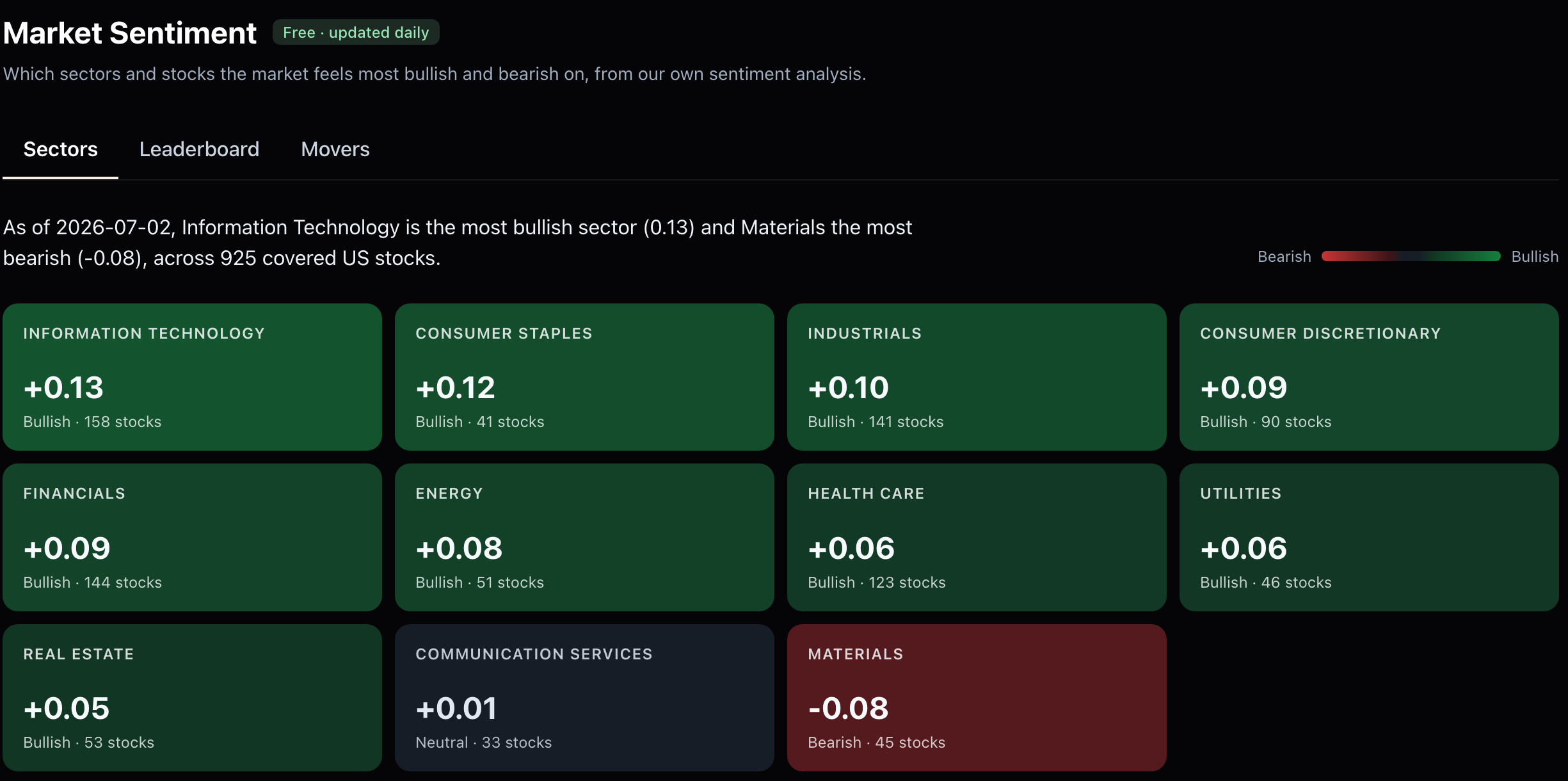
The free sector heatmap: all 11 GICS sectors ranked by the day's sentiment, from a live reading of the news and social conversation. See it live at app.sentisense.ai/sentiment.
- A market-wide read. Market Mood is a 0 to 100 composite that, unlike a pure price gauge, blends market signals with social and news tone. It is the broad thermometer.
- Which sectors and stocks lead. The free market sentiment page ranks the GICS sectors by tone in a heatmap, lists the most bullish and most bearish stocks with the story driving each, and surfaces the biggest weekly sentiment shifts. All of it updates daily.
- Per-stock sentiment. Every covered ticker has a sentiment view built from natural-language scoring of the news and social conversation about that specific company, with a directional label and trend so you see which way the tone is moving, not just where it sits. Start from any stock page, for example NVDA.
- Thematic indexes. When you want a sector or theme rather than one name, daily composites like AI Sentiment track the tone of an entire complex in one reading.
- The full data via API. Everything above is available programmatically, so you can pull per-stock sentiment into your own screen, dashboard, or agent. The stock sentiment API is what turns sentiment from a thing you check into a thing you build on.
We are honest about the limits: sentiment is a measure of the conversation, not a forecast, and it reads best as one input alongside price and fundamentals, not as a standalone buy or sell trigger.
The short version
Tracking market sentiment is not a vibe if you give it a method: read the tone of the conversation, not just the price or the mention count; favor tools that go per-stock, show their methodology, and let you pull the data out; and watch sentiment most closely when it disagrees with price, because that gap is where the signal lives.
You can start watching all of it, for free, on the live market sentiment page.
SentiSense provides market data and sentiment analysis for research and educational purposes. It is not investment advice, and past sentiment readings do not predict future price moves.