 SentiSense
Social arbitrage research on one page: introducing Consumer Pulse
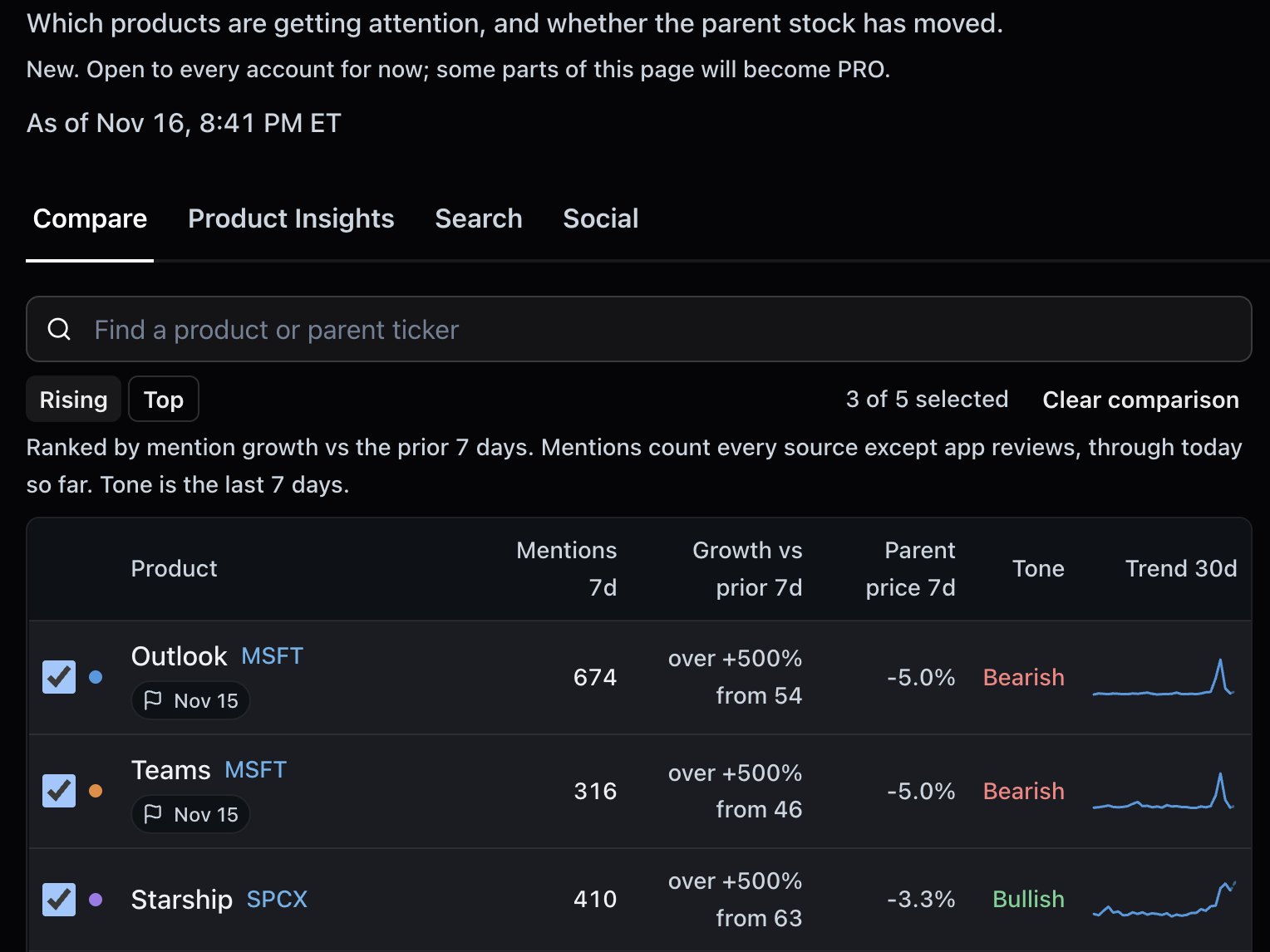
Social arbitrage starts with noticing what people are buying and talking about. Consumer Pulse, new in the SentiSense app, shows which products are getting attention and whether the parent company's stock has moved. It shows attention, not advice.

Social arbitrage begins with something anyone can do: notice what people are buying, using and talking about, then ask whether the stock market has noticed too. Today we are opening a page in the SentiSense app built for that question. It is called Consumer Pulse, and it shows which products are getting attention and whether the parent company's stock has moved.
One thing before anything else: Consumer Pulse shows attention, not advice. The page says so in its own words. Its notes describe a flag as "an attention and price divergence to research, not a trade signal", and the home page card that leads to it reads "Attention only, not a price signal". We mean both lines.
What is social arbitrage?
Social arbitrage, or social arb for short, is the practice of watching what people are buying, using and talking about, and asking whether the stock market has noticed yet. Most of us already do a small version of it: the product a friend will not stop recommending, the restaurant chain with a line out the door, the app everyone is suddenly complaining about.
Noticing has never been the hard part of social arb. Checking is. Is this product really being talked about more than it was last week, or does it only feel that way? More than its rivals? And what has the company's stock been doing in the meantime?
Why we built it
Answering those questions by hand takes an evening. You search the news, scroll through posts and videos, check how often people are searching for the name, skim app reviews, then open a stock chart in another tab and compare by eye. Every source counts in its own way, and none of them knows which company makes the thing you are looking at.
We already read that conversation every day for stocks. Consumer Pulse turns the same reading toward the things companies sell, from phones to restaurant chains, counts it the same way for every product, and places the parent company's stock beside it. If you have ever used a search-trends chart to see whether interest in something was climbing, the idea will feel familiar: this is that habit, widened from search to the rest of the conversation and tied to the company behind each product.
How it helps
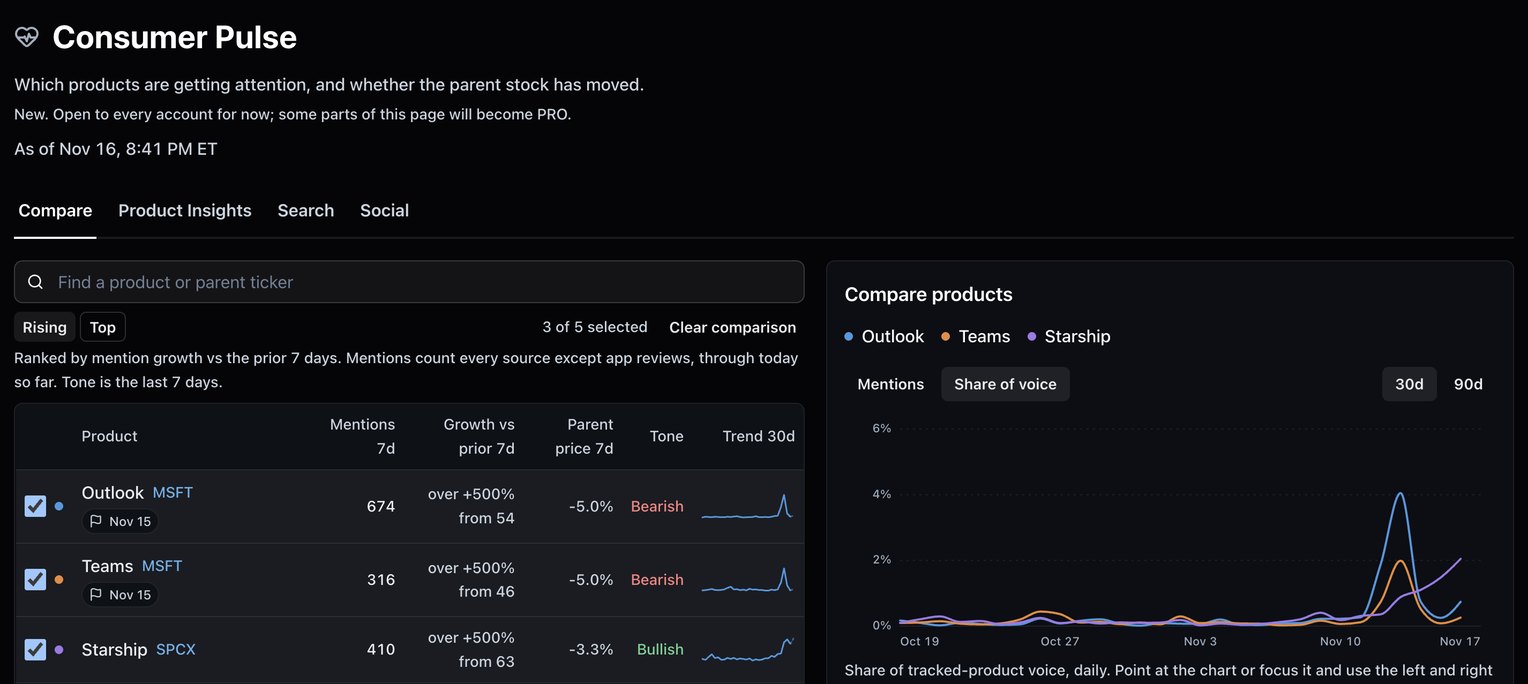
The Compare tab on its Rising view, with three products ticked and charted as share of voice. SentiSense app, captured November 16, 2026.
Start with what is rising. The page opens on the products whose mentions grew the most against the week before, with last week's count printed under this week's change so you can see what a percentage is made of. One click switches to the most talked-about products overall. Where the maker is a public company we cover, its stock sits beside the product, with how it moved over the same seven days.
Then put products side by side. Tick up to five and they share one chart, as daily mentions or as each product's share of all the product conversation we track, over 30 or 90 days. You can see which one people are talking about more, and the day that changed.
The page also marks the rows where the two halves of the question pull apart. When a product's mentions have at least doubled against the week before while the parent company's stock has stayed within 2% either way, the row carries a flag we call unpriced attention. The flag points you to a row worth reading more about. It decides nothing for you.

EPYC and Apple HomeView, both flagged on November 16, 2026. The flag marks a divergence to research, not a trade signal. SentiSense app, captured November 16, 2026.
Three more views sit beside the boards. Product Insights lists the products we have just started tracking, so new names are visible as they arrive. Search shows the search terms running above their own seasonal pattern, so something that climbs at this time every year does not read as news. Social ranks products by the change in a blended attention reading and names what drove it: mentions, reviews, search, short-form video or a company's own official posts.
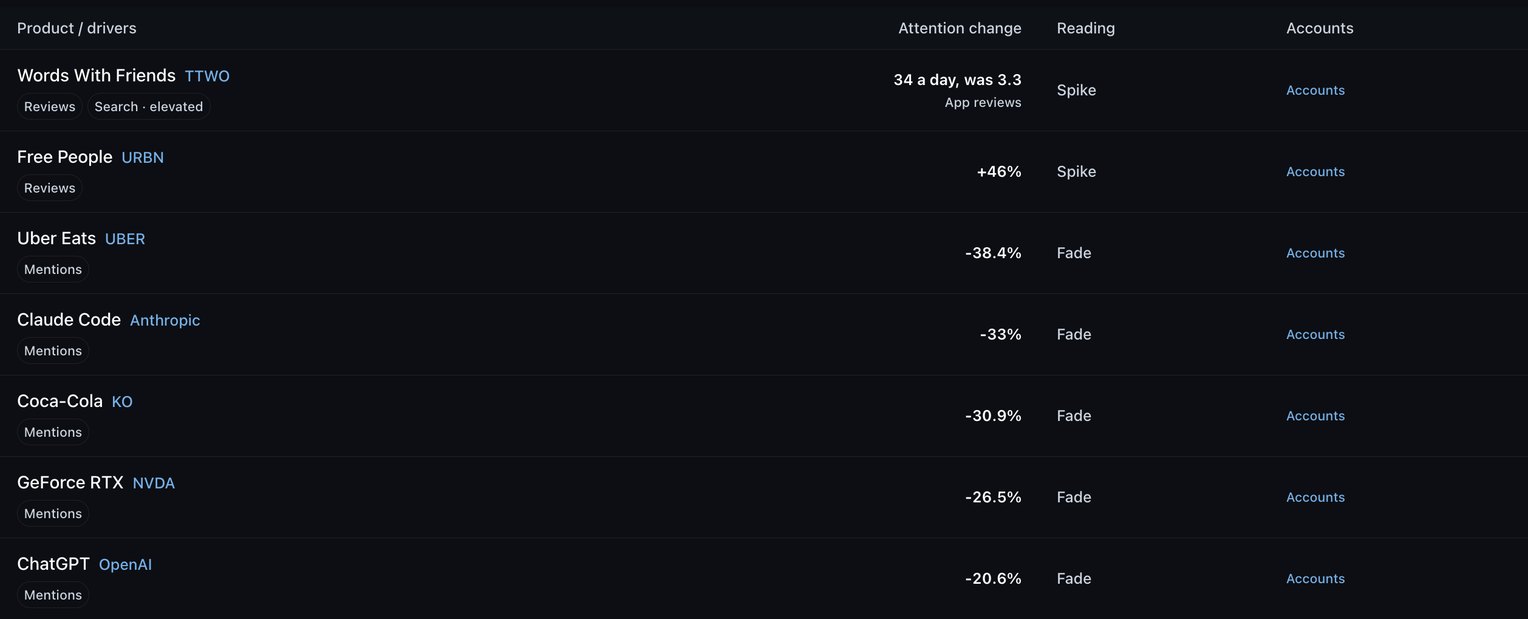
The Social tab, as of November 15, 2026. SentiSense app, captured November 16, 2026.
How does Consumer Pulse measure attention?
We keep a list of products and the companies that sell them, under the names people actually use. Each day we read news, social posts, newsletters, video and forums, and every piece that names a tracked product counts as one mention, once, on the day it was published. App reviews are counted separately and never added in.
A few rules keep small numbers from looking like big news. A product has to reach 30 mentions in a week before it appears, and a growth figure is printed only when the week before clears the same floor and the product has three weeks of history. Without those rules, a product we began tracking last week would show growth in the thousands of percent, which would measure when we started counting and nothing that happened in the world.
New names come from the coverage itself. When a phrase keeps recurring and matches nothing we track, it becomes a candidate, and a curator reviews it before it counts for anything.
The boards are rebuilt more than once a day, and the page shows the time of the run you are reading. When the last day on a chart is still in progress, it is drawn dashed and labelled "today so far", so a half-finished day does not look like a drop.
Is social arbitrage investment advice?
No. Social arbitrage is a way of doing research, and Consumer Pulse is a tool for that research. Nothing on the page is a recommendation, a forecast or personal advice, and despite the word arbitrage, nothing about it is riskless.
Does rising attention mean a stock will go up?
No. Attention rises on good and bad news alike: a launch, an outage and a recall all get people talking. One product is often a small part of the company that sells it. And when attention climbs while the price stays put, the ordinary explanation is that the market saw the same news and decided it did not matter. The page measures conversation. It does not measure sales, market share or revenue.
Who can use Consumer Pulse?
Consumer Pulse is open to every signed-in SentiSense account for now. Some parts of the page will become PRO, and the page says so under its title.
You will find it in the sidebar under Alternative Data, or by typing PULSE into the app's search bar. The home page's products card, "Which products are in focus?", also links to it.
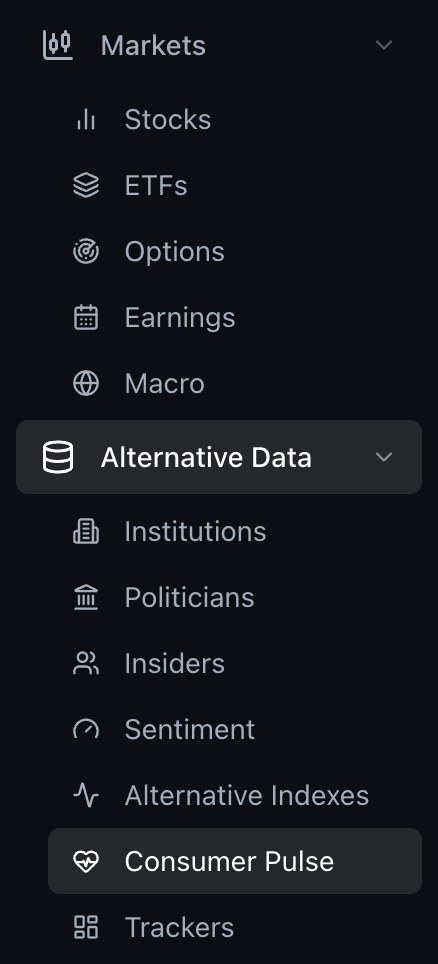
Consumer Pulse in the sidebar, under Alternative Data. SentiSense app, captured November 16, 2026.
Sign in and open Consumer Pulse. The full method is on the methodology page, and a tab-by-tab guide is in How do I read Consumer Pulse?.
For research and education only. Not investment advice.